



Shooting Stars
WORDS BY Katie Jarvis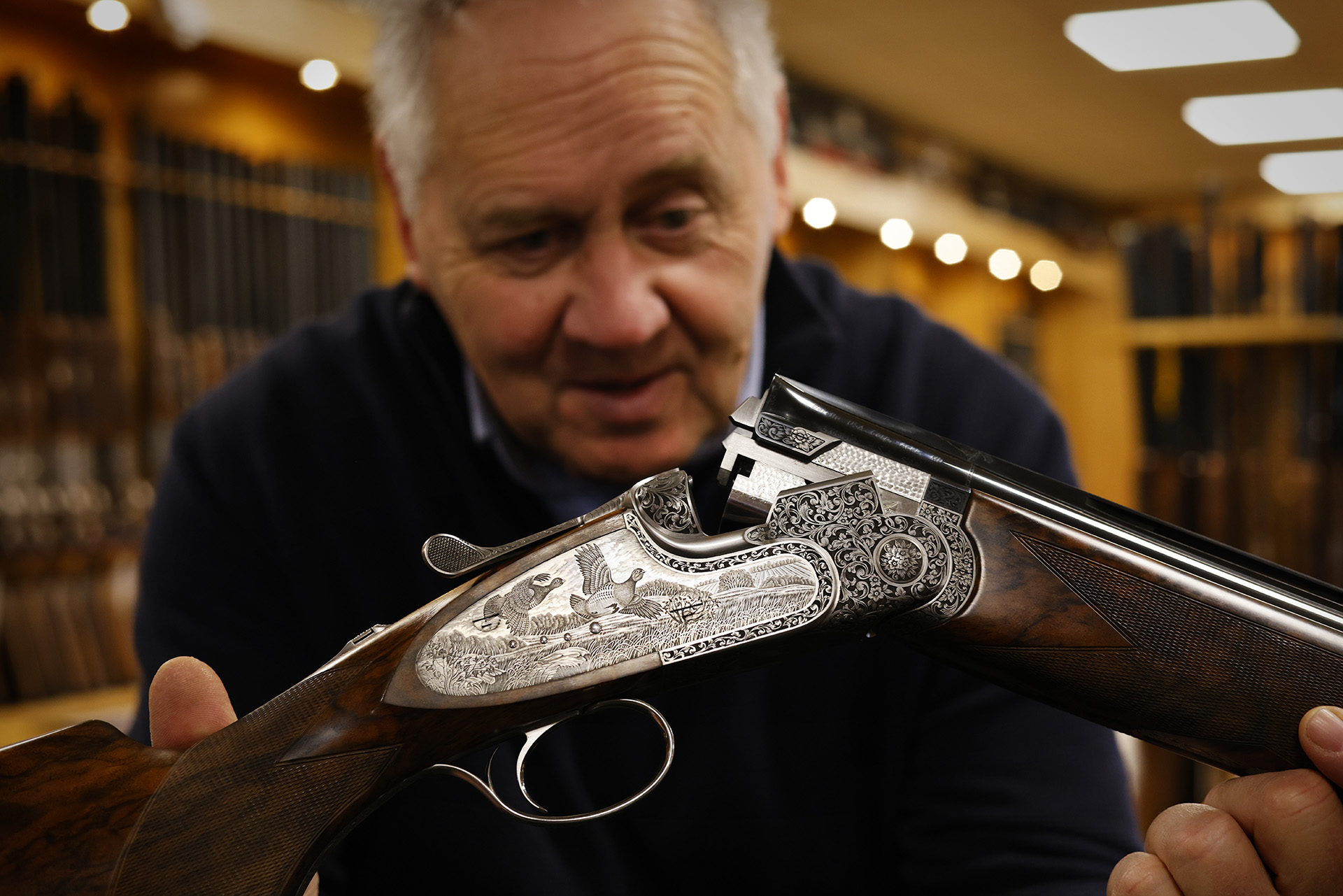
Katie Jarvis and her son Ed join Ian Coley Sporting for a morning clay pigeon shooting. Ed's already a crack shot. Katie? Not so much.
I'm under no illusions. Ed and I are up for a morning clay pigeon-shooting. On the plus side, it's lovely to go out together! On the minus side, think Jeeves and Wooster (Clue: in this scenario, I'm definitely not Jeeves). I'm here to show that anybody – absolutely anybody... in theory, can have a go at clays.
When Ed was younger, he'd go out – as the sun was just contemplating peering over the horizon – airgun in hand, to sit quietly for hours behind tussocks in dewy meadows overrun by rabbits. He studied anatomy so he could shoot sure and true. "What's this?" I'd ask, examining something in the freezer that I couldn't remember buying at Waitrose. "Squirrel." He'd respond. "Squirrel?!?" I'd then repeat back, to make sure I'd heard him right.
Later, when he got into clays, Ed was a member of the Bristol Uni shooting team. While I (the person who cannot slot a pencil into a sharpener without forward-planning) simply drove him to and from practice. Still, in for a penny. I'm sure I can bluff my way through this.
Well balanced, smooth to shoot
It's teeming as we head out of the warm, dry cafe at Ian Coley's, rain bouncing off the paving like pellets from a shotgun. We do a straight run to stand 18, one of the covered stands on the ground perfect for when the weather is being particularly British. A chap nods in friendly fashion as he passes us on the way out. "That's Sam Usher – British champion," Matt Woodruffe, our instructor, tells us. "He's one of our sponsored shooters and brand ambassadors. If he wins anything big, you'll see him in an Ian Coley cap." (I'm wearing one myself; maybe this bodes well.)
"So, yeah: guns," Matt says, as we brush off the wet. He turns to Ed. "I've got a regular 12-bore Blaser here – I don't know if you've shot a Blaser before?" Ed shakes his head. "Around £8,000 in the shop. Usually, you might get a nice engraved gun, but this one is very plain."
People will pay a (I would say 'small' but that would be inaccurate) fortune for a beautiful gun. This Blaser, however, is all about action: well balanced, smooth to shoot, and with very limited recoil. "They're really nice to shoot; really, really nice. So I just want to see you mount the gun to start off with. Are you right- or left-handed?" Matt asks.
The info on the board in front of us details four targets to choose from:
The teal, which mimics a wildfowling bird, popping up and moving away like a duck flying over marshland; the left-to-right crosser; the crow, which is incoming; and the right-to-left crosser. (The elements that make a clay more challenging include the angle it comes out at, and the speed.)
"So how fast do these go?" I ask.
"You can make them as fast as you want, really. In the past, they'd match the speed of a bird – that's what sporting used to be. But nowadays you're just trying to make a nice target... We'll do the right to left, which is this one coming up quite high," he says to Ed. "PULL!"
Ed misses – he hasn't shot for a few years now – but he knows exactly where he went wrong. "Lovely – so all you need to do there is find that spot. The only thing I would have said is that you could have that [gun] in your shoulder before you call, just to give yourself a little bit more time." Ed calls, "PULL!", again. And bingo.
Legendary name
Matt is a great instructor. Confidence-inspiring; full of sound advice, both safety and skill, and an excellent shot himself. He first picked up a gun at just 10 years old, and won't mind us mentioning that that was a little while ago now! "I began full time here about three years ago but have been coaching here for many years prior to that; the ground has undergone such a monumental change in that time but has always been a prestigious establishment with a great shooting record.
"Ian Coley wanted to be a gamekeeper but chose to establish a gun shop in 1970. Soon after this a sporting agency and then the shooting school. So, three businesses: all very different but they help each other." Matt explains.
The name Ian Coley is legendary in shooting circles, renowned for clay and game. Six-times Olympic coach, he first shot for Great Britain in 1971 and has represented his country on more than 200 occasions. "He has also coached two gold-medallists. I forgot about that!"
I listen to Ed and Matt talk guns for a while. Which ones Ed has used, which he prefers. Browning and Miroku are two names bandied about. Ah, Miroku, Matt says. "A Japanese make. They almost copied the 525 [shotgun]: Browning went over to see what they were doing and to tell them off for doing it. And then they realised that, actually, Miroku were quite good at it, so partnered."
Ed shoots through the various targets. It feels great, he says; like the proverbial riding a bike. "Not like a five-year gap at all."
How does Matt think Ed's doing? "There's not much to really say – I'm waiting for him to miss!" You wait 'til it's my turn, Matt...
Easy and natural
I can't put it off any longer. And, actually, the feel of the 28-bore Beretta silver pigeon in my arms is surprisingly easy and natural. "Is this the idiot-proof bore?" I ask. "I wouldn't say it's idiot-proof. It's one of the best beginner guns. A bit like buying a VW Golf – you know it's going to be reliable." Explains Matt. Bore-size (I learn) goes: 12, 20, 28. "So I've got a bigger bullet and, therefore, more chance of hitting something?" I ask, hopefully. Matt shakes his head with a smile. (I've clearly got a lot of knowledge-gaps to fill.) "No! The lower the number, the bigger the bore, which means the bigger the gun. You've got a smaller one because you're a smaller lady. The 28 bore will be more comfortable for you to shoot, because it's a lighter gun."
He gets me to stand with my feet shoulder-width apart. "That's perfect," he says, encouragingly, whilst helping me support the gun, which is angled up. "To start with, the gun is empty. I'm going to be putting it into your shoulder to get the feel of it."
As I begin to focus (wearing, of course, ear-defenders), everything else blots out: the rain bouncing off the roof, along with the other people around me. We do a dummy-run, so I get an idea of what's going to happen. I feel confident... "I'm going to miss!", but Matt has more faith than that. "You're not going to miss. As soon as you're ready, call PULL!" I hit half my targets – that's a figure I'll gladly take. Cat that's got the cream.
Skitter like rabbits
After Ed has skilfully worked his way through harder targets, including those such as the 'rabbits' that skitter along the ground, trickily bouncing over dips, we end up back in the shop for a debrief.
Matt tells us about the cross-section of customers who come here to shoot. "Once," he says, "I had someone shoot two at a time with one shot." A fluke? He laughs, "Well, they did it twice! It was a young lad. We were down [at stand 18] where we started, with the crow at the back and the left-to-right crosser. He went to go and shoot the left-to-right crosser and hit both. And I said, 'That's a fluke; let's do it again', and he hit both again." Did he have to buy everyone a round of drinks?
"He was only 12. He was thrilled."
"Are there people who will never be able to hit a single one?" I ask Matt. "I've never had that before. I've never had that. It's the mark of a decent instructor!" he says, proudly.
Delirious enjoyment
Steve Lilly, assistant shop manager, is showing us the Bugattis of the gun world. "Now these," he says, reverently unlocking a Beretta from a tier of beauties, "are hand-made in Italy." You choose your engraving style. "And, obviously, if you're going to invest that sort of money in a shotgun or a pair of shotguns, what you need it to do is to balance correctly and to fit you. So, you may have to visit the factory a couple of times to get that done." And that – no hardship here – means a trip to Milan; to Gardone Val Trompia, where the verdant valleys are guarded by neck-cricking mountains so rich in minerals that the Romans named this the Iron Road.
Beretta, still family owned, is 500 years old and very proud of the fact. Steve pulls out a photo on his phone. "That's their family home [pointing to a stone-built, Tuscan-style, fairy-tale villa], which is now a museum. They used to make cars until Mr Fiat paid them a visit; he decided he wouldn't make guns if they didn't make cars – so they came to a gentleman's agreement." Inside this villa (by invitation only) is the world's largest private gun collection. "When I visited the section of the factory where they make these guns – (I'll just wipe this one down before I put it back) – one thing struck me that I found very surprising: 75 percent of the workforce is under the age of 24." Kudos – passing on those craft skills. "They are family members, a lot of them, but they still have to make the grade." These guns are works of art: Turkish walnut, finest engravings (a pheasant ascending; woodcock flying above wildflower meadow), and a traditional manufacturing process where the lock and firing mechanism are attached to the side of the plate on the inside. Very expensive to produce, very difficult to achieve. "As beautiful on the inside as on the outside." Steve says.
"And you'd pay?" I ask tentatively. "Anything from £100k upward." he responds. I quiz Steve again, asking him what it feels like to hold. "I die of delirious enjoyment each time."
Can Ed hold it? 'If he scratches it, he owns it,' Steve jokes. (I assume.) I'm intrigued, if Steve himself had an open chequebook? "I'd buy a Browning B25: there isn't a finer shotgun in the world."
Like a shot
So, how did Ed and I enjoy our day? Let's put it this way. He's so fired up, he's reapplying for his lapsed shotgun licence. And would I do it again?
Like a shot.
You can shoot at Ian Coley Sporting at any level. If you're a licence holder, you can bring your own equipment; if not, book an experience or lesson with any of their professional coaches; Cheltenham GL54 4AX
SHARE: